

Next post


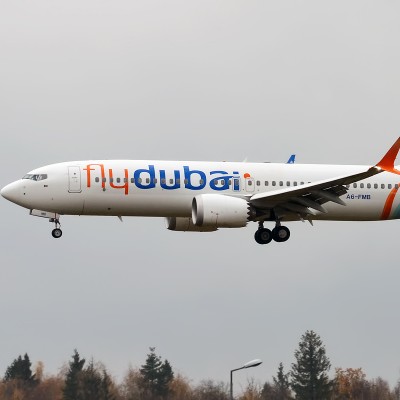
The events that unfolded on Wednesday morning on a FlyDubai flight from Dubai to Tel Aviv eerily evoke memories of Flight 93. We should all be relieved beyond belief that this story has a happier ending.
FlyDubai 1073, a Boeing 737 Max 8 had 174 passengers, plus its crew. During the flight, an emergency alert was sent from the plane, and the plane plunged some 18,000 feet. Passengers were convinced they were about to die, especially as they realized that the pilot had been stabbed.
Miriam Ohayon, whose brother was killed in the Oct. 7, 2023, terrorist attack, said all hell broke loose on board when Flight 1073 began to nosedive en-route to Tel Aviv.
After the flight captain, Smit Machchhar, released the cockpit doors, Ohayon recalled the shrieks of terror at the sight of the bloody pilot.
“We heard screams on the plane, and when they opened the cockpit, there was a lot of blood,” she told Israel’s Channel 24.
Fellow passenger Mika Bauman said the feeling of the plane losing some 18,000 feet was a million times worse than a drop on a rollercoaster.
“I was just sure I was going to die,” she told CNN. “You’re just siting there and accepting your fate.”
Fortunately, the one person who knew what was happening was also the person who enabled passengers to get control of the plane. The first hero of the day was the pilot, Smit Machchhar.
Poor guy was just trying to do his job and the guy he's supposed to be able to trust unquestionably literally stabbed him and tried to make him part of a mass murder.
Insanity. https://t.co/8eGt0pgnLy
— Sunny (@sunnyright) September 30, 2026
(Indian national Smit) Machchhar, who has nearly 10,000 hours in the air, was credited as averting a possible terror attack on Tuesday, according to Indian and Israeli outlets.
The veteran pilot reportedly fought back against his treacherous first officer and alerted the crew and passengers aboard the plane, who managed to intervene.
Despite his injuries, Machchhar was able to open the doors to the cockpit so the passengers could rush in to help.
“The last moments of his energy, he used to click open the release on the door,” Doron Spielman, a spokesperson for the Israeli prime minister’s office, told Reuters.
Machchhar was stabbed several times in the attack, officials said, with the pilot rushed to the hospital after the plane was delivered to Saudi Arabia.
After Machchhar was able to get the cockpit door open, several passengers rushed to his aid, and to attempt to get control of the plane. One of those passengers was Yaniv Hayoun, who was praised by Prime Minister Netanyahu in interviews given on Wednesday evening.
Netanyahu met with (Hayoun) earlier on Wednesday, lauding his act of courage and praising him for taking control of the plane under “impossible” circumstances.
“I met with this Israeli, this unbelievable Israeli. His name is Yaniv, who did this thing,” he explained. “And I asked him, ‘How did you do it?’ And he said, ‘Well, I just had to do it.’”
“His family was there, 174 passengers, most of whom were Israelis, were there. He had to save them.”
Hayoun was not the only passenger who jumped into action.
Hayoun described the horrifying ordeal as “complete chaos.”
“One of the pilots stabbed another pilot. He tried to crash us. When it leveled out a little, just a little, we managed to get back up,” he told The Free Press.
The co-pilot was allegedly attacking the plane’s control panel when Hayoun and the other passengers rushed in to stop him.
“I managed to open the cockpit door with the help of another crewmember. We physically fought with the co-pilot, he was going wild,” he said of the unidentified pilot.
“I put him in a chokehold, took control of him, and dragged him out of the cockpit,” Hayoun added.
His wife, Meital, explained, “They tied up the attacker using headphones at first,” and later “found zip ties and restrained him with those.”
Hayoun said he and “three other Israelis” guarded the first officer attacker while passengers administered first aid to the pilot who was “stabbed multiple times.”
“We kept him alive the entire way,” Hayoun said.
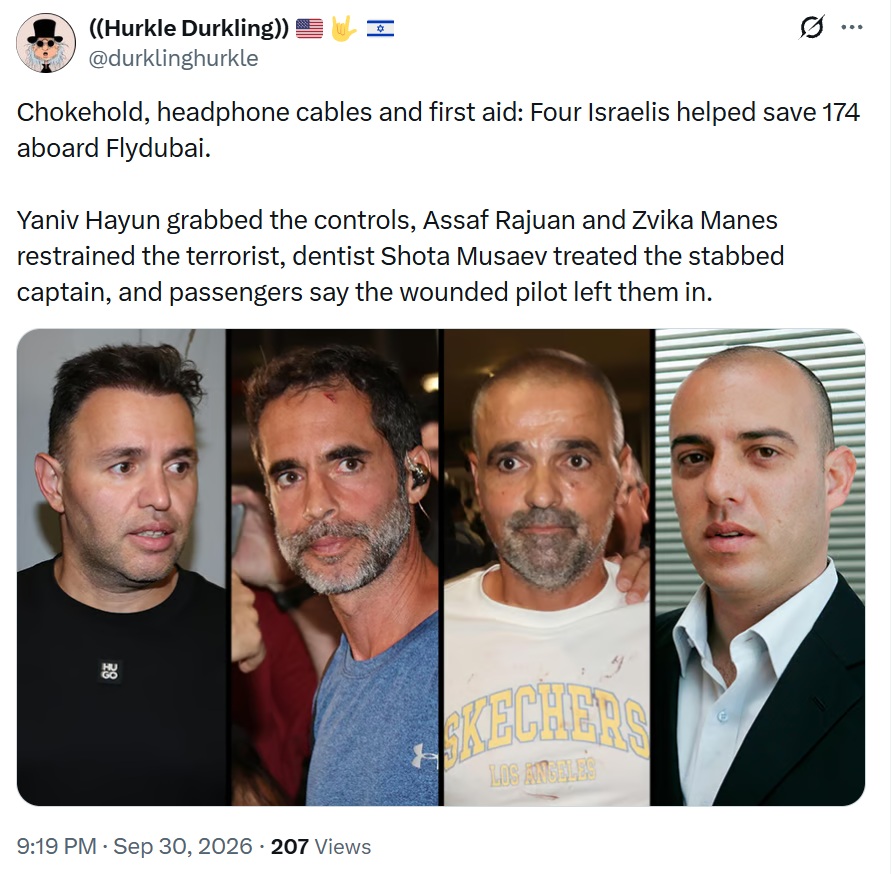
The plane made an emergency landing in Tabuk, Saudi Arabia, thanks to two relief pilots who were onboard. The plane’s rudder was damaged from the rapid descent, so landing safely was no small feat.
In the past few years Boeing have taken hits from all quarters. But no matter what you think, this is an astonishing image of a @flydubai aircraft that went well beyond its design limits (30,000 Ft per minute descent rate was reported, a normal rate is about 1500 ft per minute)… pic.twitter.com/zKaTD4L2Mq
— Scott Bateman MBE (@scottiebateman) September 30, 2026
In his interview with CBS News, Netanyahu opined that this doesn’t appear to be an act of terror on the scale of 9/11, but that the co-pilot likely intended to commit suicide and take everyone on the plane with him.
“I don’t think it was a hijacking,” Netanyahu told “CBS Evening News” anchor Tony Dokoupil.
“I think it looks like a suicide attempt simply because of what this hero Yaniv described when he went in,” Netanyahu speculated, referring to Yaniv Hayoun, one of the passengers on the FlyDubai flight who has been credited with entering the cockpit and helping to subdue the attacker.
“This guy was trying to jam the equipment between the two flight seats, the pilot seats,” Netanyahu said of the co-pilot. “He wasn’t sitting in the pilot seat trying to stabilize the plane, he was trying to jam the equipment.”
An Omani official confirmed to CBS News that the attacker, whose name has not been released, was born in Oman and holds Omani citizenship. According to Netanyahu, he is currently being interrogated in Saudi Arabia.
“He’ll be, I assume, moved very quickly to Dubai,” Netanyahu told CBS News, adding that Israeli authorities will “join the interrogation and find out what happened there exactly.”
“It could be, I don’t know, we’ll find out soon,” Netanyahu responded when asked if he thought the incident could have stemmed from a mental health issue and not an act of terrorism.
“We’ve had signs that Iran, and particularly through its proxies, was intending to heighten terrorist attacks against Israel and Israeli nationals abroad,” Netanyahu added. “But I think it’s too early to say whether there was Iranian collusion here. I think we’ll find out, won’t take a long time.”
Obviously, FlyDubai has a lot of questions to answer about this co-pilot, and what his motives were. But while the authorities in multiple countries attempt to get to the bottom of what happened on this flight, perhaps the media could try to be less awful. The initial reports that came in about FlyDubai 1073 included the information that two emergency codes that were transmitted – also called “squawk codes.”
A squawk code is a four-digit code entered into an aircraft’s transponder. The transponder sends the code to air-traffic-control radar systems, helping controllers identify and track the aircraft. Most squawk codes are assigned by controllers for routine identification, but certain codes have internationally recognised emergency meanings.
The two codes transmitted by FZ1073 were particularly significant. 7700 means a general emergency. It does not identify one particular type of problem. A pilot can use it when an aircraft faces a serious emergency requiring immediate attention from air traffic control.
7500 is the code associated with unlawful interference or hijacking. Under aviation procedures, it alerts controllers that an aircraft may be subject to hijacking or another form of unlawful interference or hijacking. The FAA says that when an aircraft squawks 7500, controllers are required to verify the code and, if confirmed or not denied, treat the situation as a hijacking emergency.
The media knew that these emergency codes had gone out, but still chose to write headlines suggesting the pilots had been in a fight with each other.
Breaking news: A plane flying from Dubai to Israel was diverted after an altercation between the pilot and co-pilot, Israeli officials said. https://t.co/VVuUXKUrPY
— The New York Times (@nytimes) September 30, 2026
And the New York Times – which acknowledges the distress codes in their initial story – was hardly alone in their glossing of the circumstances.
Pilots get into a fight? What were they fighting over? https://t.co/TqAvbydWrz
— Stephen L. Miller (@redsteeze) September 30, 2026
The NYT tried to spin their awful headline, but got pretty well roasted online for their defense. And that doesn’t even address the crazy people online who are blaming Israel or saying that Netanyahu made this all up in order to boost his poll numbers before an election.
If FlyDubai 1073 had gone down, with 174 people on board (including four Americans with dual citizenship), it would have been an international disaster with diplomatic implications that could have upset the balance that exists due to the Abraham Accords. Once we know the co-pilot’s motives, we will have a better idea if he intended to be a hijacker or a suicide bomber. Either explanation is horrific, and it is nothing short of heroic and miraculous that Smit Machchhar managed to stay alert and aware enough to unlock the cockpit door, and give the passengers and relief pilots on board the chance to save everyone else.
Featured image: FlyDubai Boeing Boeing 737-8 MAX via Anna Zvereva on Wikimedia Commons, cropped, Attribution-ShareAlike 2.0 Generic (CC BY-SA 2.0)


 Wfjag says:
 Why is the American press trying to spin this attack into a forgettable incident? Could it be that the facts are reminiscent of those of United Flight 93 and there is a tight Senate race in Michigan in which the Dem candidate refuses to denounce Islamist terrorism?
 Cameron says:
 Welcome to another example of “Islam is toxic to human life.”




Is Trump Finally Getting Results Between Russia And Ukraine?
https://victorygirlsblog.com/is-trump-finally-getting-results-between-russia-and-ukraine/
There is a lot happening on the Russia-Ukraine front right now, and President Trump is celebrating a win. However, with news very much in flux, we should...
Continue reading
The post Is Tru
FOUL: WNBA Teams Run To Locker Rooms Before National Anthem
https://victorygirlsblog.com/foul-wnba-teams-run-to-locker-rooms-before-national-anthem/
It was like rats deserting a sinking ship. During Games 1 and 2 of the WNBA Finals, the teams scurried into their locker rooms just before the...
Continue reading
The post FOUL: WNBA Teams
Mark Kelly’s White House Dreams Are Floating In Space
https://victorygirlsblog.com/mark-kelly-white-house-dreams-floating-in-space/
It appears The Hill has found another name to toss into the Democrats’ 2028 presidential circus, and this time it’s astronaut-turned-senator Mark Kelly. With the Democratic Party...
Continue read




2 Comments