Previous post


There’s a push for a $25 minimum wage, and it’s not just about wages. It’s being tied to justice and equity, and it feels like we’re still operating off the same post-George Floyd framework.
The federal minimum wage is still $7.25 and hasn’t moved in years, so of course this was going to come up again. States have already gone higher in a lot of places. But jumping to $25 federally is a different kind of move, especially when it’s being packaged as someting bigger than just a pay increase.
And it’s not just a fringe idea. It’s all aboard for the progressive Democrats.
A handful of House Democrats have gotten on board with the $25 proposal, including Reps. Chuy Garcia (Ill.), Rashida Tlaib (Mich.), Lateefah Simon (Calif.) and Greg Casar (Texas), chair of the House Progressive Caucus. It also has the backing of labor unions such as the Service Employees International Union and the National Education Association, and the advocacy group One Fair Wage, which has pushed for years to abolish the tipped minimum wage. – Huffpost
They’re not debating a number anymore. For liberals and progressives, this isn’t really about inflation or the cost of living. It’s about social justice. Still riding that 2020 summer-of-love nonsense.
This isn’t a new concept or idea. We’ve seen the same shift in other areas. Companies rolled out DEI messaging and then quietly walked parts of it back. Schools and workplaces started focusing on outcomes instead of standards and ran into pushback. Different issue, same approach—push the idea of social injustice onto everything.
Now it’s wages. A $25 minimum wage, but it can’t just be about pay. It has to be tied to justice and equity too. And once it’s framed that way, good luck questioning it without being told you’re the problem.
The @federalreserve Bank of Boston found that following a 10% increase in the minimum wage, inflation runs measurably higher in areas with the most low-wage workers.
So, the people the Squad’s Living Wage for All Act claims to help would be hit hardest. @pedrobrodrigue7 has…
— The Daily Signal (@DailySignal) April 28, 2026
Once the federal minimum wage changes to $25, then it supersedes what each individual state has set. In California, the minimum wage is $16.90. So they’d have to honor the federal minimum wage of $25 instead.
Now look at Alabama, where there’s no state minimum wage. Employers go by the federal $7.25, the same rate we’ve had since 2009. So if Washington decides it’s $25, that’s what it becomes. Just like that. No regard for how different the local economy is.
Congress couldn’t even agree on $15 not that long ago. That stalled out because of concerns about cost, impact, and how it would hit different parts of the country. Now we’re talking about $25 like it’s the obvious next step.
You all know all of this already. But I am going to play it out anyway.
If the federal minimum wage jumps to $25, it doesn’t just land on paper and stop there. A small shop looks at its payroll and realizes it can’t keep the same number of people at that rate. So hours get cut, maybe one or two positions disappear, and prices tick up to cover the gap.
The bigger chains down the road adjust differently. They’ve got the margins, they’ve got the systems, they raise prices a bit, lean more into self-checkout, and keep moving. But they’ll also probably get looted by the same people now out of work or who never worked at all, you know, in the name of “social justice.” What did Alexandria Ocasio-Cortez say? That people feel like they need to shoplift some bread or go hungry that night.
And it doesn’t land the same everywhere. In a high-cost city, some businesses are already closer to that number, so the shift is smaller. In a place like Alabama, it’s a jolt.
In 1986, Ronald Reagan called them the nine most terrifying words: “I’m from the government, and I’m here to help.” And in this case, that help comes in the form of a one-size-fits-all wage.
We’ve been down this road before. This video from years ago walks through the basics, and it still applies.
The video is nine years old, but the formula is the same, and the math doesn’t lie.
If a $25 minimum wage solved the problem, it wouldn’t still be a debate. We would have done it years ago. We’d all be rich and we’d moved on.
But instead, it keeps coming back, bigger each time, with a new label attached. Now it’s not just a wage, it’s justice. It’s equity. It’s everything.
And the people pushing it aren’t the ones trying to keep a business open or make payroll at the end of the week. They don’t have to figure out how the math works. They just pick the number and call it compassion.
A $25 federal minimum wage doesn’t just squeeze small mom-and-ops shops. It shuts some of them down and puts more people on the bread line. Which is what the progressive socialist want.
Delia Ramirez can call it justice. Analilia Mejia can call it equity. But when it leads to fewer jobs, more closures, and more people depending on the government, it starts to look a lot more like control, moving in the direction of full-blown socialism.
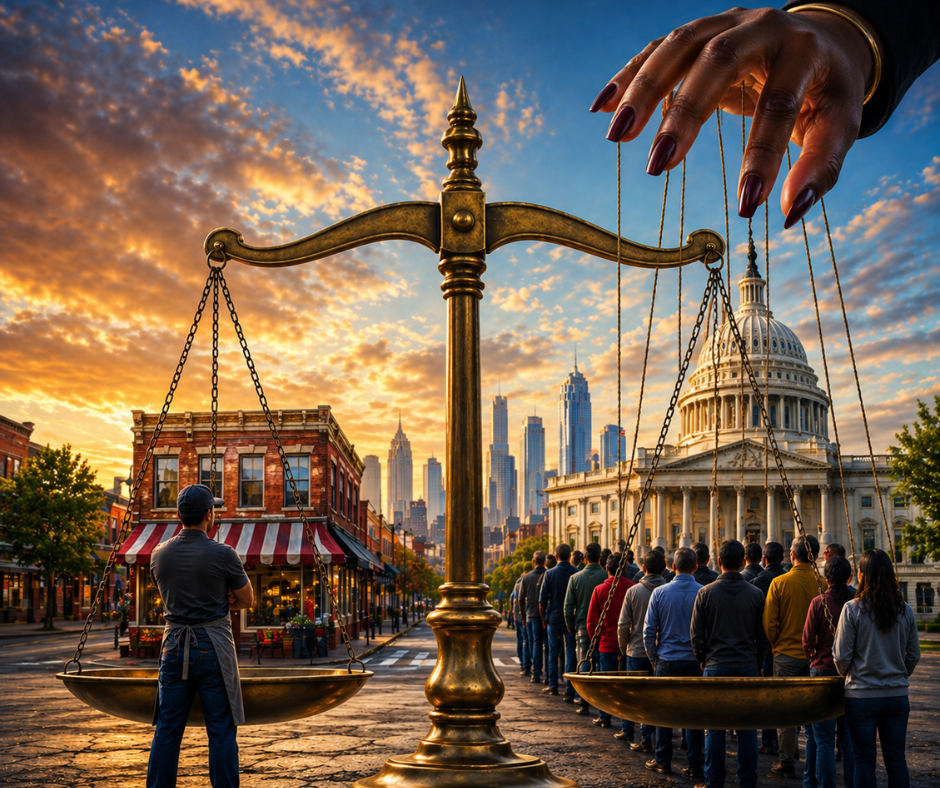
Featured Image: AI-generated image.


 Wfjag says:
 Workers in places like Seattle which have mandated ridiculous minimum wages have found that the real minimum wage is $0.00. Even those who only have reduced hours have learned that more is expected during reduced hours and less help, so that take-home pay is less.
I used to think that Progressives who advocated raising minimum wages as a solution suffered from a flat learning curve. However, as the evidence accumulates I have concluded that their learning curves are negative.


Justice for Fort Hood Isn’t “Barbaric,” Hillary
https://victorygirlsblog.com/justice-for-fort-hood-isnt-barbaric-hillary/
Hillary Clinton is aghast. Again. The woman who once shrugged off four dead Americans in Benghazi with a dismissive “What difference, at this point, does it make?” has suddenly discovered her inner m
Doug Emhoff Isn’t On Board For A Kamala 2028 Presidential Run
https://victorygirlsblog.com/doug-emhoff-isnt-on-board-for-a-kamala-2028-presidential-run/
The former Second Gentleman, Doug Emhoff, isn’t looking to become First Gentleman in 2028. As Kamala Harris begins testing the political waters once again, it seems her...
Continue…







1 Comment