
Previous post


The Nikole Hannah-Jones school saga keeps getting new details added, and none of them make her look good.
The “1619 Project” author is getting praised for her disastrous “experiment,” including getting sympathy from the devil herself, Randi Weingarten.
The serial arsonist says we must figure out how all these buildings ended up burned down and address it. pic.twitter.com/jGM7AT6sID
— AG (@AGHamilton29) September 25, 2026
Weingarten’s lament aside, Nikole Hannah-Jones has left a few salient details out of her tale of woe. First of all, she left out the detail where her own husband, Faraji Hannah-Jones, is in a volunteer job as a chairman for that same system.
If you write a piece denouncing the poor performance of a city’s public school system, that’s one thing. If you write a piece denouncing the poor performance of a city’s public school system where your husband works (in an unpaid, volunteer position) . . . well, that suggests a different subtext to that article, now doesn’t it?
While Hannah-Jones refers to her husband six times in her essay, at no point does she mention that he is the contracts committee chairman of the city’s Panel for Educational Policy.
And we know this because over the summer, Faraji Hannah-Jones was hit with complaints about using his position to promote his and Nikole’s new business venture.
Panel for Educational Policy Contracts Committee Chair Faraji Hannah-Jones used his official speaking time at the July 29 meeting at the High School for Fashion Industries in Chelsea to advertise that he and his wife Nikole are planning to open a bookstore in Bedford Stuyvesant that will push “banned” books.
“My wife and I are building an institution in Brooklyn, in Bed Stuy, called North Star Books and Bar,” Hannah-Jones said.
Hannah-Jones, who joined the panel in 2025, promised that North Star Books would be a “huge bookstore” and would sell “all the books that are banned” while his fellow PEP members looked on. Its bar, whose liquor license is pending, will sell “black-owned spirits,” according to its website.
City Councilman Phil Wong (D-Queens) denounced the self-promotion and said Hannah-Jones violated Chapter 68 of the City Charter, which prohibits public servants from using their positions for personal profit.
Now, Faraji Hannah-Jones joined that board in 2025, years after they made the decision to send their daughter, Najya, to public school. But Nikole Hannah-Jones doesn’t mention that he even has this position, that it is unpaid, or why he decided to jump in and volunteer long after the fact. Maybe she couldn’t fit it into her narrative, where she confesses that the “segregation” issues were just too much for one family to handle, and her dreams of her daughter being the next Ruby Bridges have all blown up. Hannah-Jones even admits this in her original piece, where she interviews some of the former students who took part in desegregation while they were young children.
I kept thinking about one of those children, named Leona Tate, now in her 70s, whom I met a few months earlier.
In November 1960, a 6-year-old Tate, along with Tessie Prevost, Gail Etienne and, famously, Ruby Bridges, became the first Black children to desegregate white elementary schools in the Deep South.
We tell this as a triumphal story. One in which these Black children suffered, yes, but in the end, integration prevailed and America was transformed. But when Tate was sent to McDonogh 19 Elementary School, integration did not even last until the end of the day. By 3 p.m., all the white parents pulled their children out of school.
Her parents later sent her to desegregate another white elementary school. And then a white middle school, and then a white high school. Society benefited from their dismantling of Jim Crow, but Leona Tate and the other girls wore the scars of our “advancement.” They were threatened by white strangers, hit and spit upon by white classmates and emotionally abused by white teachers. They never got the education they deserved in hopes that future generations would.
“It wasn’t easy for us,” Tate told me, “but we had to.”
I asked Tate if she felt resentment toward her parents, if she wished they had made another choice, doing what was best for her and not the country. “Noh-oh,” she said, her sweet New Orleans accent melting the word into two syllables.
“I think it was a hard decision, a courageous decision, to put your children on the front line like that. And I probably would do the same thing. I’m glad I did what I did when I did it. Somebody had to do it.”Maybe my own child would also come to appreciate what she experienced one day, or at least, why we did what we did.
The first problem with this narrative, of course, is that Nikole Hannah-Jones HAD options, and had been GIVEN those options by her own parents, and still decided that her own child should be given up for “the greater good.” The other problem with this narrative? Other parents at the school where Najya went say that the Hannah-Joneses were a PART of the problem, and fought loudly against a rezoning that would have “gentrified” the school.
In a 2016 fight against the “yuppie invasion” of Brooklyn’s PS 307 school, as local reports dubbed it, the Hannah-Joneses stood firmly against a Department of Education rezoning initiative, which seemed poised to flood their kid’s school with local tots from wealthy backgrounds.
This despite the couple themselves being well-off non-native New Yorkers living in Bed-Stuy in a completely different school district.
At the time, nearby public school PS 8 was overflowing with students, at 148% capacity and had a multi-year waitlist.
PS 307 Daniel Hale Williams school, located in Vinegar Hill, was underutilized, at just 50% capacity. The re-zoning plan carved out the gentrified Dumbo neighborhood from PS 8 and assigned it to PS 307 Daniel Hale Williams school in Vinegar Hill.
After the local board voted in 2016 to pass the school integration initiative, irate husband Faraji — who had been elected PS 307 PTA co-president — demanded limits on how many new kids the school could take in.
The newly assigned Dumbo neighborhood was roughly 70% white and 11% Asian.
Referring to quotas of kids from the neighboring housing projects he fought to secure, Faraji said at the time: “When we said 50%, we didn’t say 50% with conditions. We said 50%, period.
“We want the opportunity to sustain our equity for that neighborhood. We don’t want PS 307 to become PS 8,” he said at a 2016 community meeting, referring to the school which had rapidly become one of the borough’s best and most desirable, partly through benefits from gentrification. At that time 85% of the school’s pupils were white.
“When those affluent parents come in, we do not want to alienate the parents who live across the street in the Farragut [housing project],” Hannah-Jones, himself among the affluent, noted.
Parents who were there at the time say that the school actually had a good principal and was a good school. Then it all fell apart when that principal left – something that Nikole Hannah-Jones also says in her story.
David Goldsmith, president of the Community Education Council for District 13, which voted to approve the rezoning, told The Post that PS 307 was a standout, magnet school at the time Najya enrolled, thanks to former principal Roberta Davenport.
“Roberta had built an amazing school,” Goldsmith said. “[The Hannah-Joneses] sent their kid to 307 probably because they heard what she was doing. She had a lot of funding, wouldn’t take no for an answer, had all sorts of program and grants.”
But Davenport suddenly retired in June 2015, one year into Najya’s enrollment, and everything the principal built crumbled under her replacement, Goldsmith said.
At the same time the war against the “yuppies” had reached fever-pitch and PS 307 had become a citywide lightning rod for one of the most divisive topics of the 2010s: Brooklyn’s gentrification.
But it never happened at PS 307. The year after rezoning, fewer than 10 white kindergarteners enrolled, according to a Politico article. Today, the school remains about 6% white, according to DOE data, suggesting Dumbo parents opted for other options, including gifted-and-talented programs, charter or private schools.
In an email to The Post, Hannah-Jones said she and Farraji “never” opposed integration of the school and they “were fighting that the decision was being made without input from PS 307 and Dumbo parents.”
She said their aim was to “slow the process down to ensure parents had input and the rezoning came with a certain percentage of seats that would remain for low-income students to try to prevent the possibility of the school completely flipping, like PS 8 did, and losing any chance for stable integration.”
And the parents are pointing fingers.
Past and current members of that school’s community told The Post the controversial scribe only has herself to blame.
“They were trying to take over the school . . . Things that couldn’t go their way, they felt, ‘We’re going to write it down and start trouble.’ They were imposing their will on the school,” Ebony Richardson, a former PTA chair and current volunteer at the school, told The Post.
Current parents who spoke to The Post rejected Hannah-Jones’ characterization.
“When I read it, I was confused. I think it’s horrible. I would never use my child like that,” a 46-year-old stay-at-home mom who sent three kids to the school told The Post, referring to sending Najya to the school. “If her child was failing, that’s on her.”
A 27-year-old father dropping his child off for school at PS 307 on Tuesday morning called Hannah-Jones’s stunt “selfish.”
“Do you want the best for your child or just to prove yourself right?” the man, who identified himself as “Mr. Jones,” told The Post. “If you were using your daughter as an experiment and it failed, don’t blame the school. I think that’s selfish.”
A video from January 2020 shows Faraji Hannah-Jones, in his role as PTA co-president, talking about PS 307 and openly bragging that he was married to Nikole Hannah-Jones, and that she had written an entire essay about sending their child to this school BECAUSE it was low-income. He actually tells the audience to go read that essay while he complains about “gentrification,” while also pushing the “1619 Project” curriculum! He is asking parents to send their children to this school while admitting that it has academic problems.
Faraji and Nikole Hannah-Jones chose this school, and then tried to make sure it fit their narrative. Now they are looking to blame that same school and same system after being deeply involved in the process the entire time. Nikole mentions Faraji “being involved” with the PTA and “writing checks” for the PTA, but somehow, they just “missed” checking on their own daughter’s homework for all those years, and just trusted that the grades she was getting were okay, even after admitting that they knew the new principal was disengaged and the teaching staff followed suit. Oh yeah, and that principal who let everything fall apart? She’s now the Department of Education’s chief of literacy. Nikole Hannah-Jones doesn’t say anything about that in her article, does she?
Nikole Hannah-Jones is searching for absolution from her own daughter, and is hoping that by doing this publicly, Najya will be guilted into giving it to her – all while Faraji attempts to cast her as a “civil rights leader” on the scale of Martin Luther King Jr. As more details and videos leak out, that absolution looks further and further away, and their own thumbs on the scale look more and more obvious.
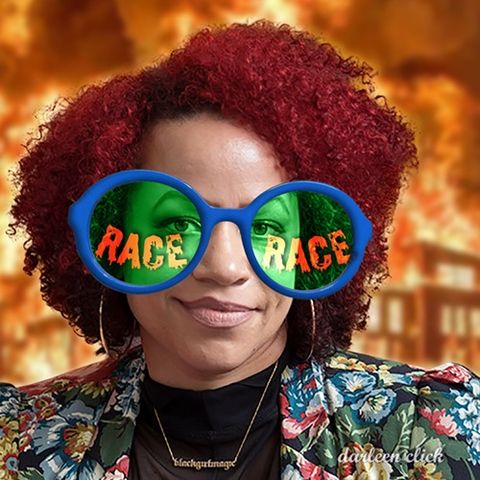
Featured image: original Victory Girls art by Darleen Click




 Scott says:
 How much does a yone want to bet that the replacement principle that let it all go to shit was a.DEI hire????



Democrats Are Distancing Themselves From AOC’s Political Aspirations
https://victorygirlsblog.com/democrats-are-distancing-themselves-from-aocs-political-aspirations/
Yes, AOC has aspirations for higher office. Whether that is taking Chuck Schumer’s seat in the Senate, or swinging for the White House is the question. There’s...
Continue…
Salon’s Amanda Marcotte’s Obsession With MAGA Needs An Intervention
https://victorygirlsblog.com/salon-amanda-marcotte-maga-obsession/
Salon’s Amanda Marcotte has once again wandered deep into MAGA America. And once again, she has returned with tales nobody who actually lives here recognizes. This time,...…
Clancy Juror Has His Lawyer Giving Interview To Defend Him
https://victorygirlsblog.com/clancy-juror-has-his-lawyer-giving-interview-to-defend-him/
The Lindsay Clancy murder trial may be waiting for a hearing tomorrow, but the juror who refused to go along with the insanity defense now has a...
Continue reading
The post Clancy…
The Feminist Revolution and That Pesky Fine Print
https://victorygirlsblog.com/feminist-revolution-pesky-fine-print/
Feminism was supposed to make women stronger, happier and freer. But after several generations of liberation, maybe we’re finally old enough to ask an impolite question: did...
Continue reading





1 Comment