Previous post


The story itself is no surprise. A government project in California turning into a financial boondoggle?? How on EARTH could this have happened to such a fiscally responsible and progressive-minded state?
Yeah, I’m laughing at that last line, too.
There are actually two things of interest in noting the continued failure of the construction of high-speed rail in California. First, that “60 Minutes” covered it, and directly pointed the finger at California government officials for this absolute screw-up of a project.
I guess this is the Bari Weiss effect at work, because even the mention that President Trump cut $4 billion in federal grants to this project barely raises an eyebrow when reporter Jon Wertheim confronts the current state secretary of transportation, Toks Omishakin, about the $126 BILLION that he would like to see committed to this project, but that it still would leave them with a shortfall of $90 BILLION. What are the odds that a “60 Minutes” report about this project before Weiss became editor-in-chief would have emphasized the $4 billion denied over the $126 billion projected cost with a still-huge funding gap?
The project was approved with $9.95 billion initially earmarked for it, with the final cost expected to be around $33 billion. But nearly two-decades of delays have sent that price tag soaring.
California High Speed Rail Authority board member Anthony Williams — a former legislative affairs secretary for California Gov. Gavin Newsom (D) — told Wertheim the project is now expected to cost around $125 billion.
“It wasn’t. Let’s be real,” Williams said when asked if the financing was there to complete the project when it first launched.
“I don’t think the voters fully understood — and neither did we in the public sector — what it was going to take to actually get this project delivered,” California Secretary of Transportation Toks Omishakin said.
Wertheim noted the train’s projected $126 billion price tag is “more funding than Amtrak has received in its history, and still leaves a shortfall of roughly $90 billion.”
“That’s a big gap to fill,” Wertheim told Williams.
BREAKING: California doesn't have enough money to finish building a high speed rail system to connect San Francisco and Los Angeles and now they want $125 BILLION MORE!
"The entire amount of money we need is not there…"
And now they want more money than Amtrak has EVER… pic.twitter.com/CBe2heU0MK
— Steve Guest (@SteveGuest) April 5, 2026
And it’s no surprise why this project had cost overruns before even one mile of track was laid.
When California voters approved a bullet train between Los Angeles and San Francisco in 2008, the estimated price tag was $33 billion, with a target completion date of 2020. Nearly two decades later, the California High-Speed Rail Authority is preparing to lay its first tracks to connect Bakersfield and Merced — a portion of the original route — with a target completion of 2033.
Rep. Vince Fong, a Republican representing California’s Central Valley, sits on the House Transportation and Infrastructure Committee. He says that when California voters first approved high-speed rail, the promise and price tag were more of a marketing campaign than a realistic projection.
“We’re now in 2026. There are no trains. There’s no track laid,” he said. “It was a complete bait and switch.”
To get the necessary political buy-in from the whole state, the plan called for the train to run inland, threading the farmland of the Central Valley. But at the time, the California High-Speed Rail Authority hadn’t answered basic questions, like precisely where it could lay down its tracks, the public and private property the route would traverse — what’s known as right of way.
So far, the state has had to negotiate roughly 3,000 parcels of land to run its train through the Central Valley leg, Omishakin said.
California’s environmental regulations have also slowed the process. Those regulations have triggered years-long reviews, lawsuits and delays — which, combined with the relatively high cost of labor and construction in the U.S., have also added to the price tag.
In short, the money disappeared into a black hole of environmental studies, legal wrangling, and the increasing costs of labor and materiel, and now the route will go literally nowhere that anyone wants to go. Bakersfield to Merced is not what was sold to the public, but California Democrats – who control the state – have apparently bought into the sunk-cost fallacy.
Here is the other interesting thing about this “60 Minutes” story. Governor Hair Gel, Gavin Newsom, is nowhere to be found. And not because Jon Wertheim didn’t ask.
In 2019, with costs ballooning and the timeline years off schedule, bipartisan political pressure mounted.
“Right now, there simply isn’t a path to get from Sacramento to San Diego, let alone from San Francisco to L.A.,” Gov. Gavin Newsom, who inherited the project, said at the time.
Under Newsom, who didn’t respond to repeated interview requests, California decided to focus on completing that initial Central Valley segment. It’s a route few are likely to ride, according to the Rail Authority’s own projections. The ultimate goal remains connecting northern and southern California.
Newsom was elected as governor in 2018, following two terms as lieutenant governor. He has spent the last 16-plus years at the very top of California state government. And he refused to give an interview about this colossal failure that he has the power to STOP because it has wasted enough time and money. So why won’t he stop it?
My personal opinion is that Newsom has given up caring about what happens next in California. He is term limited out after this election, and his entire focus is now on running for president. He’s too afraid to endorse a successor, because he’s worried about losing political allies in the future. And the last thing he needs is to pull the plug on a construction project that has paid lawyers, government officials, and union employees quite well up until now. He needs all of those groups to support him in future campaigns. Stopping California from going off a financial cliff to pay for pet projects is not on Newsom’s list of things to do.
And yes, California is in financial straits. That $125-126 billion won’t even get the line finished, just that Bakersfield to Merced chunk. That other $90 billion needed is just a projected shortfall for the REST of the project – and that is money that California does not have, as the Hoover Institution pointed out in 2024.
California’s budget went from an assumed $98 billion surplus, in which there was so much cash in state coffers that Gov. Gavin Newsom was giving away $50,000 to randomly selected individuals to get a COVID-19 vaccine, to a projected $73 billion deficit in only about two years.
Much of this could have been avoided if, in 2022, California hadn’t made obvious, enormously unrealistic revenue assumptions for future years that falsely painted far too optimistic a fiscal portrait for the state. In a nutshell, here is what happened: in fiscal year 2021‒22, state tax revenues rose around 55 percent—about $70 billion—over the previous fiscal year. This revenue windfall significantly reflected taxpayers realizing capital gains, particularly high-income taxpayers who were facing a marginal tax rate of 13.3 percent at the time.
However, Newsom’s budget staff assumed that the revenue bonanza from 2021 would not just continue but would grow to an even bigger bonanza in future years. These revenue assumptions were patently unrealistic, particularly with the long-standing history of capital-gains revenue crashes following booms and with the stock market declining considerably in real time during the first half of 2022.
Despite this, Newsom’s staff predicted revenues for fiscal years 2022‒23 and 2023‒24 that were roughly $80 billion higher than what was realized.
To put the 2022‒24 revenue prediction errors in perspective, New York is the only state that had a general fund budget at that time exceeding this error.
Chalk this up as yet another reason why Gavin Newsom is a very weak Democratic presidential candidate. Any reasonable Democrat with half a brain, and the ability to do math on a calculator, should be able to tear him apart during a primary. But Newsom’s potential future campaign failure won’t help California now. Someone is going to have to have the political willpower to pull the plug on this project, or rescale it significantly to something that will actually attract riders. If Eric Swalwell becomes the next governor, nothing will change. It seems California is determined to run the gravy train straight into the ground, and who knows who will be left to pick up the pieces after that.
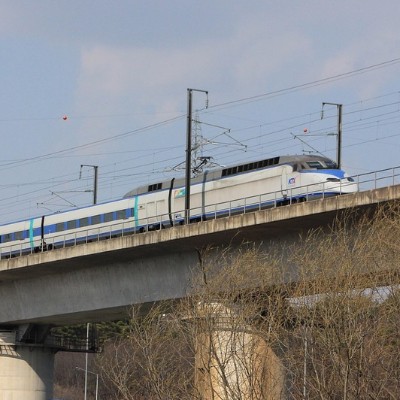
Featured image via zheng2088 on Pixabay, cropped, Pixabay license



 Cameron says:
 The love for high speed rail is due to the average democrat’s need to control everything. If you are forced into a magical train, you are at the mercy of the train system instead of being some kind of savage and driving yourself. The money you are talking about is chump change if they can get more control over us.








1 Comment