
Previous post


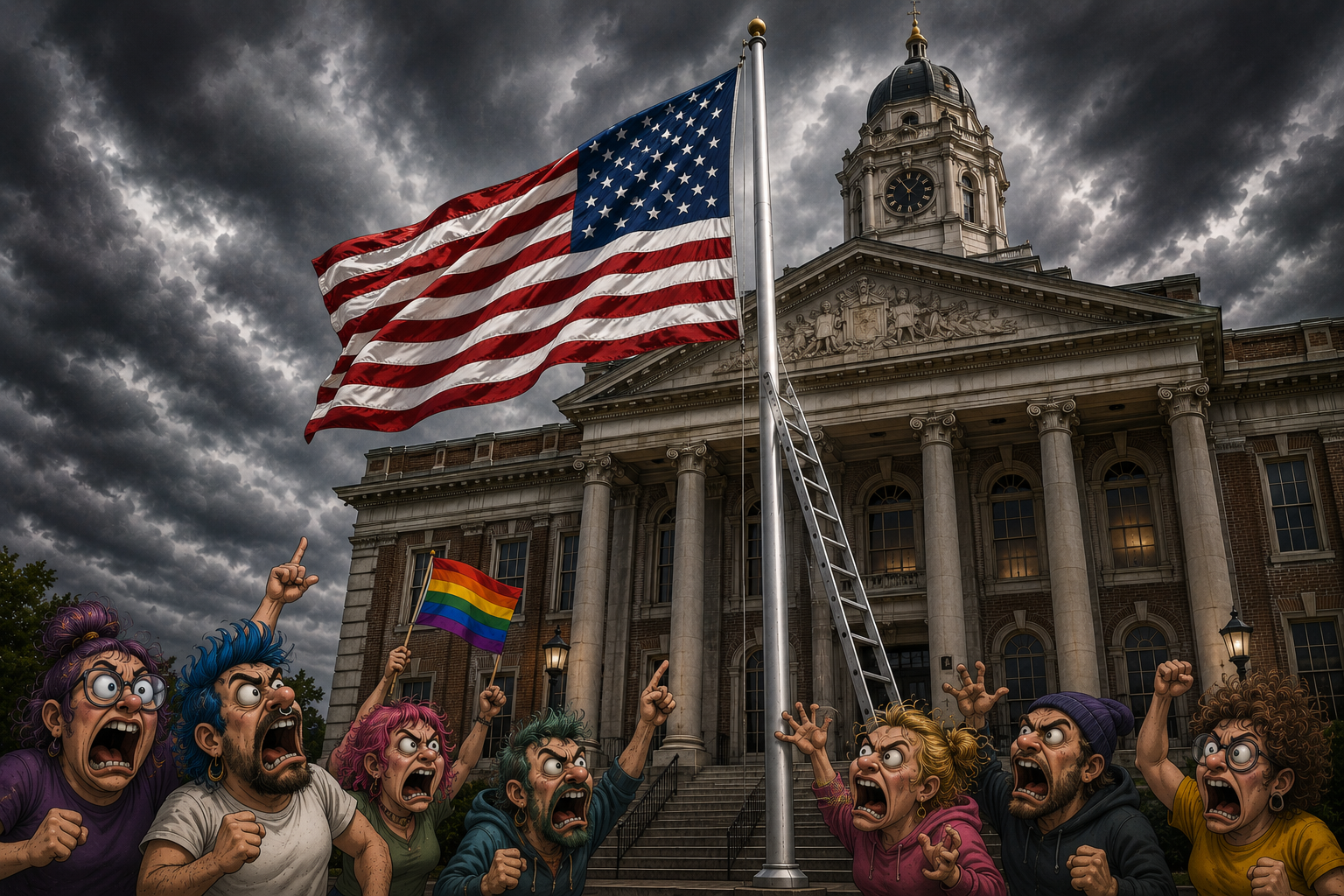
A town in New York recently decided that the only flags flying over Town Hall should be the American flag and the state flag. You would think they had outlawed oxygen. Instead, what actually happened was much less dramatic.
The town adopted a policy limiting government property to government flags, the pride flag came down, and protesters immediately descended upon Town Hall to express their outrage. Listening to some of the reactions, you would have assumed that basic civil rights had been suspended rather than a flag policy updated.
One woman explained that the pride flag is about including people who were born a certain way. That’s lovely, but I was under the impression that the American flag had already been covering that assignment for the past 250 years.
I try not to underestimate the ability of Americans to overreact, but some of the comments made outside Webster Town Hall genuinely deserve a moment of appreciation. Remember, we’re talking about a flag being removed from a government building. That’s it. Now read this and try not to pull a muscle rolling your eyes:
At the removal, protesters gathered outside Town Hall, and some LGBT activists screamed and yelled about the flag removal, which was captured on video taken by town supervisor candidate Kevin Lockhart. One woman wearing a rainbow sweater claimed she “nearly died five times in the last month,” supposedly over LGBT opposition. Another said “children will kill themselves for this.” – Daily Wire
The interesting question is not why people support pride. People are free to support whatever causes they choose. The real question should be why the absence of one rainbow flag on one government building provoked such an emotional response in the first place.
WATCH: The Town of Webster has taken down its Pride flag this morning, despite protests criticizing the move.
Full story: https://t.co/yO6RT7RykJ pic.twitter.com/vT8LDXmVvw— News 8 WROC (@News_8) June 5, 2026
Supporters of the pride flag often frame these disputes as battles over visibility and inclusion. That argument becomes more difficult to make with each passing year.
Pride is not some underground movement struggling to be noticed. It has an entire month dedicated to it. Major corporations wrap themselves in rainbow branding every June. Professional sports leagues host pride events. Politicians issue pride proclamations. Retail stores devote entire displays to pride merchandise. Even people who would prefer to avoid the subject altogether are unlikely to make it through June without being reminded repeatedly that pride month exists.
That reality makes the Webster controversy worth examining. If a movement already enjoys extraordinary cultural visibility, why does the removal of a single flag from a single town hall become a crisis?
The assumption underlying much of the outrage is that removing the pride flag somehow sends a message that LGBT residents are unwelcome.
I do not see it that way.
The American flag does not belong to one political party, one religion, one race, or one sexual orientation. It represents every citizen equally. Gay Americans are not excluded from that symbol. They are included within it, just as every other American is.
That is why many people are perfectly comfortable with government buildings displaying the American flag and little else. The flag already represents the entire community. It does not become more inclusive simply because someone hangs extra flags next to it.
Nothing about Webster’s decision prevents anyone from advocating for LGBT causes.
People remain free to organize events, hold rallies, raise money, celebrate pride month, wear rainbow clothing, and express their views publicly. None of those activities depend upon a town hall flagpole.
That is what makes some of the reaction so curious. A movement that enjoys widespread corporate support, extensive media coverage, political backing, and cultural prominence should not be endangered by the absence of a single government-displayed symbol.
At some point, the demand stops looking like a request for acceptance and starts looking like a demand for official endorsement.
Perhaps the most revealing part of the story came after the vote, when someone reportedly lowered the American flag and raised the pride flag above it.
In a strange way, I appreciate the honesty.
Critics have long argued that pride activism is no longer seeking acceptance but demanding cultural supremacy. The person who altered that flagpole may have done more to advance that argument than a hundred opinion columns ever could.
The controversy in Webster was never really about cloth and colors. It was about what government symbols are supposed to represent and whether every political or cultural cause is entitled to official recognition.
The town’s residents did not vote to take away anyone’s rights. They voted to fly government flags on government property. The intensity of the backlash raises a more interesting question than the original vote ever did.
If pride already has a month, corporate sponsorships, political support, media attention, public celebrations, and widespread cultural recognition, how many flags does acceptance require?
Feature Image: AI-generated illustration.


 SFC D says:
 “Pride month” is not about acceptance. Acceptance is easy, but for much of the LGBRQ+ crowd, it’s not enough. They want us all to celebrate their sexuality, their lifestyle, with all the variations that come with it. I refuse. I do not care if you are gay, straight, bi, whatever. Love who you want to love, it does not matter to me one bit. Love each other and look after each other. It does not have to be celebrated, it does not have to be a spectacle. The whole “pride” bit has surpassed its shelf life and is rapidly becoming counterproductive.
 OldAv8r says:
 “… The American flag does not belong to one political party, one religion, one race, or one sexual orientation. It represents every citizen equally.”
I read that and headed for the comments to say essentially this..
“… pride activism is no longer seeking acceptance but demanding cultural supremacy.”
So you beat me to it Carol.
 alanstorm says:
 “At some point, the demand stops looking like a request for acceptance and starts looking like a demand for official endorsement.”
I’d say that point is right at the very beginning.
 SCOTTtheBADGER says:
 The pride flag wavers demand that they be recognized as more special than anyone else. How sad.
I believe the only flag that can fly above the US flag is the US Navy Church Services flag.
Which I grant you is actually a pennant.





4 Comments