



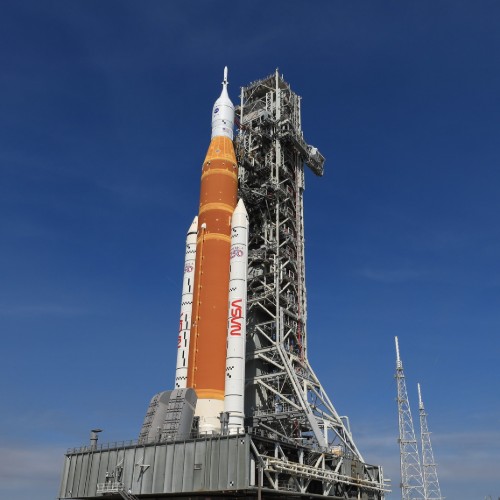
If you didn’t watch the liftoff of Artemis II on Wednesday, then you really missed out on something amazing.
And if you missed it, here it is.
This was a launch years in the making, but using older technology.
The Artemis II launch marks a risky, expensive, technically challenging landmark — the formal reopening of human ambition to explore deep space. Human spaceflight may almost seem familiar and humdrum these days, with astronauts living at the International Space Station for prolonged periods and a commercial spaceflight industry regularly sending people into low Earth orbit. But going to the moon is inherently more dangerous. It means going farther and faster, relying on hardware that has never been used to transport humans anywhere, much less the moon.
“I think this is right up there with the first launch of the space shuttle in 1981. That was the first launch of a new launch vehicle, and it had a crew on board, which was kind of a daredevil move,” said Todd Harrison a senior fellow at the American Enterprise Institute who follows space policy. “This is a capsule that’s only flown once. It had problems the first time it flew. And now we’re sending it with a crew out to the moon.”
In an era of private and commercial space contracts, this is a traditional mission, drawing on a heavy-lift rocket and capsule developed by NASA over more than a decade.
There are four astronauts onboard for this mission, which is scheduled to take place over the next ten days.
The astronauts — commander Reid Wiseman, specialists Christina Koch and Jeremy Hansen, and pilot Victor Glover — settled into orbit within 10 minutes of blast off, and will spend the next 24 hours circling the Earth while testing out the rocket systems in preparation for its final launch to the moon.
That launch — known as the translunar injection burn — will take place Thursday, just over 25 hours into the flight and will launch the Orion capsule into the vastness separating Earth and the moon.
The crew will be travelling through that space — known as the cislunar space — at over 22,000 mph as they begin the roughly four-day journey to the moon.
During that time they will put the Orion capsule through its paces with numerous systems test to make sure it will be able to perform when its carrying humans to the moon and later on the months-long journey to Mars.
Artemis II’s crew will also fire their engine for several minor trajectory corrections during the trip to make sure they don’t crash into the moon or fly past it into the depths of space.
Earth will be shrinking in spacecraft windows all the while, and by day five the capsule will have been snagged by the Moon’s gravitational field of influence and begin falling towards it.
Day six is when the main event begins — the astronauts will fly by the moon and get the closest look anyone has had since Apollo 17 departed in 1972.
It’s during that time that Artemis II is expected to make history by sending humans further from Earth than any have travelled before — breaking a record set in 1970 when Apollo 13 flew 248,655 from home.
Artemis II will then use the moon’s gravity to slingshot the Orion back to Earth using nothing but Isaac Newton’s fundamental laws of physics — the only time the capsule’s engine will be fired over the return trip is for further trajectory-correction burns.
But back on Earth, the hot takes began before Artemis II even lifted off. For example, these dumbasses at The Verge, who are very concerned that using resources found on the moon to build a base on the moon will violate international law.
You can’t parody these people. https://t.co/tu3StN1iDZ pic.twitter.com/bJ0tWuoprn
— Bonchie (@bonchieredstate) April 2, 2026
Or this guy, who told Gen Xers that their legitimate Challenger-related PTSD was just all in their heads because ACKSHUALLY, no one watched it LIVE. (This Gen Xer begs to differ, and I will stress the landing as well after watching Columbia’s burning wreckage streak across the sky live on TV.) The ratio and Community Notes are something to behold.
99.9% of people who "experienced" the Challenger disaster saw it on replay and now remember it as live.
Almost NO ONE was watching. Everyone thinks they were. It's a fascinating collective false memory. https://t.co/T1vKcdV4l0
— Dave W Plummer (@davepl1968) April 1, 2026
And then there was Chuck Schumer, who posted on X that NASA’s funds had been “cut repeatedly” by the Trump administration. One problem…
President Trump and Republicans funded NASA through the OBBB, which is what has made this possible.
You voted against it. https://t.co/9e0Jf6MBLs
— RNC Research (@RNCResearch) April 1, 2026
Fact check – true, with Schumer calling the signing of the OBBB a “betrayal.” Oopsie!
But at least the kids know that seeing the Artemis II mission liftoff is a once-in-a-lifetime moment.
Kid just SMOKED a CNN reporter outside of Artemis II launch:
CNN: "Why do you want to be here?… Why do you love being a part of history?
Kid: "We're going back to the f*cking moon, that's why!" 🤣https://t.co/olarncM5jA
— Libs of TikTok (@libsoftiktok) April 1, 2026
Language aside, that kid has the right idea. This is a very important and overdue moment for America, and for humanity. A moment like this is uniting, and awe-inspiring. We should be able to just enjoy the moment of technological advancement and human spirit without getting bogged down.
Godspeed and safe travels, Artemis II!
Featured image: Artemis II on the mobile launcher on February 25, 2026, photo by NASA/Kim Shiflett via NASA Flickr, cropped, under NASA image use policy, CC BY-ND 4.0













Leave a Reply