



The current situation between Iran, the rest of the Middle East, the Strait of Hormuz, and the United States and Israel’s restraint is unsustainable in the long term. And President Trump knows it.
Ever since active combat ended, the “ceasefire” – that has been far more fiery than should have been allowed – has largely been seen for what it is, a stalling tactic by Iran. They offer up peace deal terms that are non-starters to President Trump, who has been consistently adamant that Iran cannot have a nuclear bomb, so they don’t get to keep their enriched uranium, and then the media acts stunned when these terms aren’t accepted. Iran has been very busy planting information in the media ecosystem.
This report from Iranian controlled media is not true and the MOU they “released” is a complete fabrication. Nobody should believe what Iranian state media is putting out. FACTS MATTER. https://t.co/agpTnBSgKu
— Rapid Response 47 (@RapidResponse47) May 27, 2026
Iran has been trying to play on Trump’s desire for a peace deal to play for time. However, it is being reported that President Trump is trying to leverage the Abraham Accords in order to create an accountability structure to keep Iran in line. He wants the big players in the region to sign on to the Accords, and then they would be part of the solution to pressure Iran, isolating the country by uniting everyone else against them. But are the other countries willing to play ball with Trump?
Trump’s idea, should he stick to it, could endanger a U.S.-Iran peace deal — governments may walk away from mediating talks rather than risk angering their publics by establishing ties with Israel. But some Middle Eastern officials aren’t taking Trump’s demand too seriously, saying they view it as merely the U.S. president trying to appease hawkish Republicans who worry he will give away too much in talks with Iran.
“It is a smart tactic to calm down the angry base,” a Gulf Arab diplomat said, having been granted anonymity, like others, to discuss sensitive diplomacy. “He will keep bringing it up again and again. But it will not be part of the deal.”
Trump wrote on Truth Social on Monday that he was “mandatorily requesting” that countries such as Pakistan, Egypt, Turkey, Qatar and Saudi Arabia sign on to the accords. He noted that he’d raised the idea in a Saturday call about Iran peace talks with leaders of many of the same countries. In his post, Trump suggested even Iran could join the accords, despite the Islamist regime’s decades of hostility toward Israel.
Some of the countries Trump mentioned, such as Bahrain and the United Arab Emirates, already are part of the Abraham Accords. Others, such as Egypt and Jordan, have peace treaties or other agreements with Israel.
For others, joining the accords anytime soon could be risky. In the wake of the Gaza war, Saudi Arabia has said it will not establish ties with Israel unless its leaders agree to a serious pathway to creating a Palestinian state. (At the same time, Saudi Arabia, like several other Arab countries, sees Iran’s Islamist regime as a destabilizing force in the region).
A Gulf Arab official said the Saudi position had not changed on either the Iran crisis or the Israeli-Palestinian conflict, despite Trump’s entreaties regarding the Abraham Accords.
“The Kingdom is supportive of all diplomatic efforts to resolve conflict, not military solutions,” the official said in a statement. “The kingdom also opposes all forms of aggression. Its position on the two-state solution being the only sensible way forward has not changed.” The statement did not directly mention the accords.
Would Trump take a deal with Iran without other nations signing on to the Abraham Accords? Probably, but we also know that Trump’s end goal is to get these bigger nations to sign on the dotted line of the peace treaty. The president had a lot to say during today’s Cabinet meeting regarding the current situation in Iran – and may have signaled that his patience is wearing thin.
President Trump claimed Wednesday that Iran is “negotiating on fumes” after Tehran wrongly thought they could “out-wait” his interest in ending the three-month-old war.
“I think it looks like they want to just make a deal. I don’t think they have a choice,” he said. “… They thought they were going to out-wait me.”
“You know, ‘We’ll out-wait him. He’s got the midterms,’” Trump said of Iran’s assumptions. “I don’t care about the midterms. Look at what happened last night. That was the prelude to the midterms.”
“People understand it: They know that, very simple, Iran cannot have a nuclear weapon,” he added.
While the president still prefers a diplomatic solution with Tehran, he made clear that he’s only willing to wait so much longer before returning to the battlefront.
“Iran is very much intent, they want very much to make a deal. So far they haven’t gotten there — we’re not satisfied with it,” he said. “It will be either that or we’ll have to just finish the job.”
The entire cabinet meeting can be watched here, and while the above comments are getting plenty of attention, Trump continued with his “maybe, maybe not” strategy throughout the whole meeting.
President Donald Trump said Wednesday the U.S. could make a “good deal” with Iran now, but warned that a military option could produce a “great deal” that would be “nastier” but “foolproof.”
“I can say that, we can make a good deal right now, but maybe not a great deal,” Trump said at Wednesday’s monthly Cabinet meeting at the White House, when asked whether an Iran deal could be tied to more countries joining the Abraham Accords.
Trump said he would not disclose what is or is not contingent in the negotiations, but suggested the U.S. still has stronger options if diplomacy fails.
“If it’s not a great deal when I’m making it, because we can make a great deal with this guy right here,” Trump said, pointing to his left at War Secretary Pete Hegseth. “It’s a lot nastier. Probably wouldn’t go as quickly … but it would be foolproof.”
The president was adamant that Iranian control of the Strait of Hormuz was a hard no.
“International waters – nobody’s going to control it,” Trump said during the question and answer session during Wednesday’s monthly Cabinet meeting. “We’re going to watch over it. We’ll watch over it. But nobody’s going to control it.”
Trump said control of the Strait is part of ongoing negotiations, suggesting Iran wants a role in managing the passage.
“This part of the negotiation that we have, they would like to control it. Nobody’s going to control its international waters,” Trump said.
The president also referenced Oman, which Iranian state TV had earlier claimed could help manage ship traffic through the Strait under a disputed draft framework.
“And Oman will behave just like everybody else,” Trump said. “So we’ll have to blow them up. They understand that. They’ll be fine.”
And when Trump was asked about the Abraham Accords, he reiterated that he wants the other nations to join.
Trump says Gulf nations owe it to the United States to join the Abraham Accords. pic.twitter.com/esY3vvHidH
— Kassy Akiva (@KassyAkiva) May 27, 2026
Regardless of what other nations decide to do, Iran is definitely saying one thing at the negotiating table and another to everyone else.
Ah okay https://t.co/DX8prcNkfU
— Sunny (@sunnyright) May 27, 2026
Actions do indeed speak louder than words, and the Iranian regime, fully controlled by the IRGC, continues to act like they want to be the aggressor. At some point, hopefully in the very near future, President Trump will simply oblige them. We have seen the president’s willingness to use force when diplomacy is not working, and force is a universal language that Iran does understand.
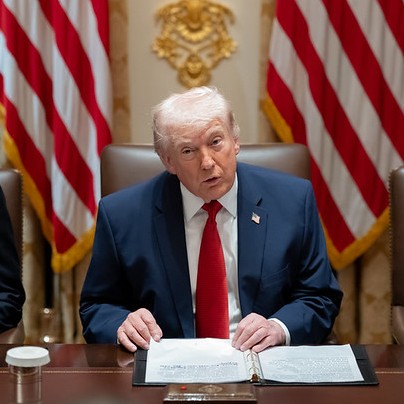
Featured image: President Trump at the March 26, 2026 Cabinet meeting, official White House photo by Emily J. Higgins, cropped, public domain








Leave a Reply