


Congratulations, New York City. Not only do you get a socialist mayor sworn in on New Year’s, but you are getting his vapid art influencer wife, Rama Duwaji, in the bargain as well.
You’re really going to love this Gen Z first lady, New York City. Even though it is painfully obvious that she would rather not be in this role. You see, she is an ARTIST. She has HIGHER ideals and bigger goals in life than just being Zohran Mamdani’s wife. While she loves the art scene of New York City, rubbing shoulders with the hoi polloi is not on her bingo card as first lady.
The 28-year-old illustrator lamented her newfound fame in a fawning profile published by New York Magazine on Tuesday, insisting she would be “absolutely” focused on her career after her husband’s inauguration on January 1.
“I’m definitely not stopping that. Come January, it’s something that I want to continue to do,” she said.
Duwaji, who didn’t give any interviews during her socialist husband’s mayoral campaign, hinted that she would use her new platform to support undiscovered artists.
“At the end of the day, I’m not a politician. I’m here to be a support system for Z and to use the role in the best way that I can as an artist,” she said in the wide-ranging interview, using her nickname for Mamdani.
“There are so many artists trying to make it in the city — so many talented, undiscovered artists making the work with no instant validation, using their last paycheck on material,” Duwaji said.
“I think using this position to highlight them and give them a platform is a top priority.”
Woe is me, I married the nepo baby who no one thought would actually win a primary, much less the office of mayor is not a good look for Rama Duwaji. Big wedding in the private compound with armed security in Uganda, great! Having to live in Gracie Mansion, not so much!
In December, Mamdani announced via Instagram that he and Duwaji had both decided to leave their rent-stabilized one-bedroom apartment in Astoria, a neighborhood that went solidly for the mayor-elect and has a sizable Muslim population, and move into Gracie Mansion on the Upper East Side, a neighborhood that has been less than enthused about Mamdani’s ascent to power. Duwaji will now have for neighbors some of the very people who have lobbed the loudest accusations of antisemitism and the baldest Islamophobic attacks on her husband.
Duwaji takes a breath, pausing when I ask her about becoming an Upper East Sider, and then deflates. “It’ll be fine. I’ll be down the street from the Guggenheim and the Met. It’ll be really nice to just explore a new part of the city,” she says before relenting. “And I’m right across the river from Astoria still, so it doesn’t feel too far away.”
As Kirsten Fleming writes in the New York Post, the entire article just highlights how young, vacuous, and self-centered Rama Duwaji appears to be.
Born in Houston and raised in New Jersey and Dubai, Duwaji has little life experience and even less experience in New York City. Like many of the people who voted for her husband, she’s a recent transplant, having moved to the Big Apple in 2021.
What she has is a sense of personal style that’s arty and hip. She’s attractive in an offbeat way and makes a striking model in dark clothing with exaggerated silhouettes, even if some of the outfits look like they’re from the closet of a cartoon villain.
Not that she isn’t interested in politics. Just not so much the issues of New York City.
“Speaking out about Palestine, Syria, Sudan — all these things are really important to me … It feels fake to talk about anything else when that’s all that’s on my mind, all I want to put down on paper,” she says.
“Everything is political.”Mamdani is quoted in the piece, too, revealing that when he got serious about running for mayor, Duwaji told him, “100 percent go for it.” But when it comes to the attention — and yes, some online trolling — she’s received, he said, “She did not sign up for this.”
Except she did. This is what it means to be a public figure in 2025. No matter what side of the aisle a politician occupies, their spouse is a fair target.
Even if Duwaji did make herself scarce on the campaign trail, choosing to let her portfolio of nakedly political art speak for her.
While she is obviously politically motivated when it comes to her art and all the pro-Hamas crap that she has posted, she comes off in the article as shallow and pretentious. You get the impression that she supports Hamas and all of Mamdani’s radicalism because she thinks it is the “cool” thing to do, not out of any particular driving conviction of her own.
That impression is only supported by her comments about how he now has more followers than she does on Instagram, and her flippancy about marriage.
Best known for her pen-and-ink portraits, predominantly of Arab women, her work has been commissioned by The New Yorker, Vogue, and this magazine. “I joke with Zohran that I had more followers than him back in the day,” Duwaji says.
When Duwaji met Mamdani in 2021, he was already in the State Assembly. And even if she recognized quickly that he was passionate and driven, both their eventual romance and his future job as the leader of one of the largest cities in the world were beyond what she ever imagined. “I never necessarily dreamed or had a very idealistic scenario of what marriage would be. Even the word wife feels very intense,” she says, laughing. “I just feel like a forever girlfriend.”
When Duwaji met Mamdani on Hinge in August 2021, she, like many single women who had just started going out again post-pandemic, wasn’t particularly looking for anything serious. “I was sort of having a hot-girl summer,” she tells me. “I didn’t necessarily expect it to happen so soon, but it was a very lovely surprise that it worked.” The then-assemblyman swiped right on her first, to which Duwaji responded with a direct message. “I’m not afraid to yap, so I think I must have said something first,” she says. “Our conversation was really brief, maybe, like, five exchanges, and then we met up pretty soon after that.”
They got married in a courthouse wedding earlier this year, and then had the big bash in Uganda later, but by that time, Mamdani was deep into running for office and it is clear why he wanted the legal wedding all wrapped up and done before the mayoral primary campaign took off. The “running for mayor” discussion was happening well before they officially tied the knot – and you get the impression that Rama Duwaji might not have said yes if she’d known he would actually win.
The concept of Mamdani running for mayor was broached slowly between the couple in early 2024. “We had a final conversation that summer before the campaign launched that October. We sat down and went through all the pros and cons. There are sacrifices that are made when you submit to a year — and obviously more now — of running a campaign and potentially winning,” Duwaji says. “It was sitting down and talking about ‘Here’s the worst-case scenario; here’s the best-case scenario.’ We talked through how we’d work through it as a team. It felt like he really valued my opinion and support.” Though ultimately she told her husband to “100 percent go for it,” Mamdani says he never would’ve launched his campaign without Duwaji’s blessing. “We had a chance, and it was a very small chance. I described it then as a 3 percent chance of winning the race,” he says. “And I also said that I was going to give everything I had to the campaign and that inevitably this would start to transform our lives, and that’s why it had to be a decision that we made, as opposed to one that I made and told her about.”
In February 2025, Mamdani was still polling in last place at one percent, but his campaign picked up steam the next month after a video of Mamdani protesting at the State Capitol went viral. It was then that the couple’s prediction that their lives would be transformed quickly came to fruition. The mayor-elect’s campaign raised $250,000 in just 24 hours. Mamdani had officially arrived in the race, which meant the public interest in their marriage was sure to intensify.
And now that he is going to be mayor, she sounds mildly pissed that she is tied to him.
It also forced her to accept that she was no longer a private citizen. “I realized that it was not just his thing but our thing,” Duwaji says. “I wasn’t necessarily offended, but it was more the perception of being seen as someone’s wife. I was spiraling about how, that night, the first article to come out was like, ‘Who Is Zohran Mamdani’s Wife?’ Blah, blah, blah, blah. And I was so upset because that one article showed up when you searched my name and not an interview I did on my art, or my work, or the things that I’ve done and the achievements that I’ve had as an artist. And now there’s, like, a bajillion of them.”
Well, this has all the hallmarks of a loving, supportive, and fulfilling marriage. *cough* So, what we’ve learned so far is that Rama Duwaji sees herself as a Very Important Artist who met Zohran Mamdani on a dating app, married him because he needed a wife to run for higher office, and his parents’ wealth meant she could continue doing her own thing without, you know, making money. But then the impossible happened, and Mamdani actually won the primary by appealing to the Gen Z women just like his wife. And then Mamdani won the general election. You can tell that Rama Duwaji never actually expected that to happen.
And now she’s stuck, lamenting her new lot in life of actually having to be a public figure, married to the incoming mayor of New York. I think the article wants us to feel sorry for her, while calling her “stunning and brave” at the same time. The only question now is, how long until Zohran Mamdani convinces Rama Duwaji that they need to have a baby to boost his poll numbers?
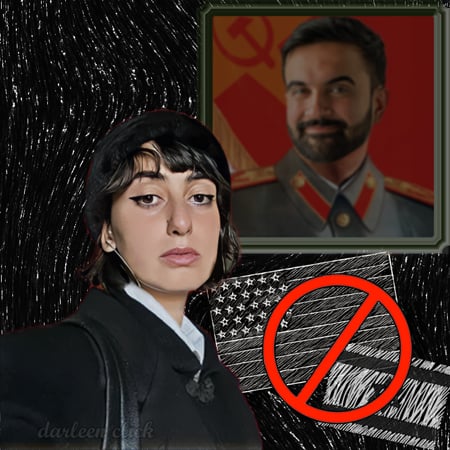
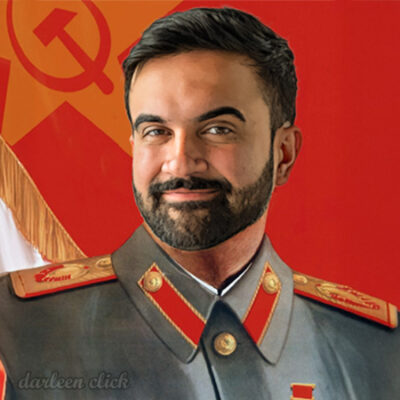
Featured image: original Victory Girls art by Darleen Click




Leave a Reply