


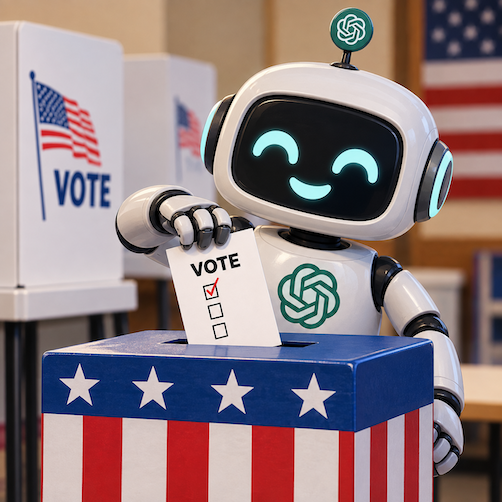
Apparently, ChatGPT has made its way into the voting booth. Well, not literally, but NPR is concerned that more Americans are using AI chatbots to research candidates and sort through their midterm ballots. The worry is that ChatGPT might do more than just answer questions. It might actually influence the person asking them.
I’m not sure why using ChatGPT to research a ballot should raise red flags on its own. It’s a tool. I’ve used it to help me figure out a quilt pattern, find a healthier recipe, create a garage gym workout, clean up grammar and punctuation, and research things I want to know more about. Political research isn’t some giant leap from there.
Voters are turning to ChatGPT and other AI chatbots to compare candidates, check claims and work through races that get little traditional coverage. That makes political research faster, but the same conversational style can quietly mirror what someone already believes. Experts warn that a voter can leave more confident in a position without actually learning more. The ballot is becoming a conversation with a machine.
— DARKCOM (@DARKCOMBUZZ) October 5, 2026
And no, that doesn’t mean I blindly believe everything ChatGPT tells me. I don’t blindly believe everything Google tells me either. If something matters, I check it. Show me the source. Let me read it for myself. ChatGPT can do some of the digging. It doesn’t get to do my thinking for me.
That’s pretty much what NPR’s Adam Johnson appears to be doing. The 40-year-old West Virginia voter spent hours using ChatGPT to work through the races on his ballot and compare candidates on issues that mattered to him.
People have been seeking out information that confirms what they already believe since long before ChatGPT showed up. We pick news outlets, follow people on X, watch YouTube channels, and scroll social media feeds that tend to give us more of what we already like. Some people are getting their news from TikTok, for crying out loud. How do you think AOC and Mamdani got elected? And maybe that’s the point NPR is trying to make.
ChatGPT can get things wrong, and it can be too agreeable. But if it gives me accurate information that happens to reinforce something I already believe, I’m not sure that’s the problem. Maybe the facts simply backed me up.
None of these concerns are exactly new. Back in 2023, OpenAI CEO Sam Altman was questioned in the Senate about ChatGPT and elections, including the possibility of it producing false information about polling places. Altman acknowledged the concern, but he also made an important distinction: ChatGPT is a tool being used by a person.
Of course, plenty of people won’t bother to check. We already have people forming political opinions from a 30-second video somebody chopped up and tossed onto social media. Giving those same people a chatbot that can produce a confident-sounding answer in seconds doesn’t suddenly make them better researchers.
And that’s where I will give NPR some room. ChatGPT shouldn’t be treated like an oracle. Neither should Google, TikTok, X, cable news, or your Facebook friend who suddenly became a constitutional scholar last Tuesday.
I also have to remember that most of the general population (GenPop™️) isn’t made up of news junkies like those of us who write and read sites like Victory Girls. A lot of people aren’t following politics every day or keeping track of who’s who. Then election day rolls around and suddenly they’re looking at a ballot full of names they’ve barely heard of. I can understand why they’d turn to ChatGPT and ask, “Okay, who are these people?”
NPR also points out that information about smaller, down-ballot races can be hard to find. That’s very true, just think about tthe lack of local news these days. And no more newspapers. So if I’m staring at three names for county commission and know nothing about any of them, why wouldn’t I ask ChatGPT to help me start digging?
Because if I go to their campaign websites, I already know two things are going to happen: a donation box is going to pop up before I can read anything, and every candidate is going to tell me exactly what they think I want to hear.
And we’re worried about ChatGPT being a people pleaser?
Use it. Ask questions. Make it show you where the information came from. Then go look for yourself.
ChatGPT can help you research your ballot. It doesn’t get to vote. You do.
Feature Image: AI-generated photo. Yep.








El-Sayed Gets Caught Up In Dual Citizenship Snafu
https://victorygirlsblog.com/el-sayed-gets-caught-up-in-dual-citizenship-snafu/
Despite what the polls say (and they say it is a dead heat within the margin of error), Abdul El-Sayed is looking for help in Michigan. Remember,...
Continue reading
The post El-Sayed Gets
Loudoun County Schools Give Pride Month an Encore
https://victorygirlsblog.com/loudoun-county-schools-pride-month-encore/
October isn’t just for fall, changing leaves and pumpkin spice anymore. Loudoun County Public Schools has added LGBTQ+ History Month to the calendar, because evidently June wasn’t...
Continue re
Fort Hood Terrorist Nidal Hasan Will Get Execution By Firing Squad
https://victorygirlsblog.com/fort-hood-terrorist-nidal-hasan-will-get-execution-by-firing-squad/
The Fort Hood killer, Nidal Hasan, committed his terror attack in 2009. He was sentenced to death in 2013. His time on this earth is coming to...
Continue reading
The post Fort…
FlyDubai Co-Pilot Terrorist Should Never Have Been Allowed Into The Cockpit
https://victorygirlsblog.com/flydubai-co-pilot-terrorist-should-never-have-been-allowed-into-the-cockpit/
It was a cascade of security failures. Security failures involving three countries and FlyDubai Airlines. And the fallout from this will not be pretty. Before Hamam…







Leave a Reply