
Previous post


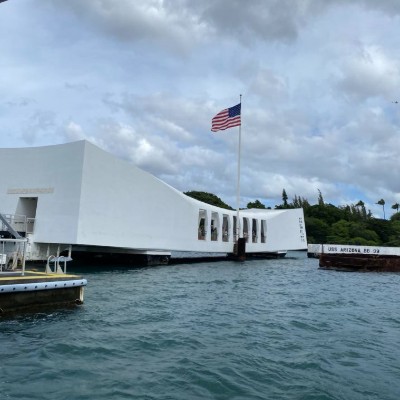
Eighty-four years ago today, America changed forever. Death rained down from the sky over Oahu, and the waters of Pearl Harbor became an inferno, and the USS Arizona became a tomb.
The other ships that were sunk that day – with the exception of the USS Utah on the other side of Ford Island – were eventually raised. The USS Oklahoma, who lost so many men that day, would never fight again, and eventually sunk to a watery grave in the Pacific when she broke her tow on her way to California to be sold as scrap in 1947. The USS West Virginia was also raised, salvaged, and refitted in time to rejoin the war in July 1944.
But the USS Arizona was a complete loss. Not only had so many souls on board been instantly killed and cremated, but the damage to the ship itself made it unthinkable that the ship would ever be seaworthy again. Salvage work began almost immediately.
While other warships at Pearl Harbor were recovered and refitted, the Navy quickly abandoned the idea of reviving the Arizona in its entirety. But crews worked on the wreck for months, removing equipment, cutting away mangled metal, searching for bodies, and reclaiming weaponry.
The Arizona’s forward deck sagged as the hull collapsed, sending its two fore turrets into the water. However, the guns mounted in a pair of turrets at the stern of the ship remained mostly unharmed and above the surface of the harbor.
As early as January 1942, the Navy informed the US Army’s Hawaiian Department that several guns and sets of support accessories from damaged battleships might be available for coastal defense. The Arizona’s two rear mounts, each equipped with a trio of 14-inch 45-caliber rifles, were all but guaranteed. A third turret, most likely the ship’s partly submerged turret number two, was possibly an option at a later date.
While these guns were mounted for coastal defense, others went to a sister battleship.
It is no surprise, as the tense months gave way to long years and the United States slowly wrestled back the Pacific from the Japanese, the work on Hawaii’s defensive positions slowed, but never fully stopped. In the interim at Pearl Harbor, another set of guns were extracted from the wreck of the Arizona’s half-submerged turret number two and sent to a shipyard in New York for relining, ready to be installed in another vessel.
The ship that received the Arizona’s trio of guns was the USS Nevada (BB-36). A veteran of Pearl Harbor, Nevada was also a part of the fighting near Attu, Atlantic convoy runs, the bombardment of Normandy on D-Day, and fire support for Operation Dragoon. After all of that action across the globe, it is no wonder the battleship required new gun barrels.
Shipyard crews installed the Arizona’s guns from turret number two into Nevada’s turret number one position in the fall of 1944. Soon after, the Nevada was back at sea, poised to pummel Iwo Jima and then Okinawa in 1945.
But as the salvage operations – and the war itself – ended, the question of what should happen to the wreckage, that was now a gravesite, began. The Navy began with simple daily recognition of the site in 1950.
Early gestures of remembrance began on the hulk itself; in 1950 Admiral Arthur W. Radford, then Commander in Chief, Pacific (CINCPAC), ordered a flagpole mounted on the Arizona and directed that the U.S. flag be raised and lowered daily over the ship. On the ninth anniversary of the attack, a plaque was placed at the base of that flagpole. These acts formalized the Arizona as a sacred site and kept public attention on creating a permanent memorial.
The Pacific War Memorial Commission had been established a year prior, in 1949, before Hawaii was officially a state. The commission laid the groundwork for what would come next – fundraising. But this process took years, and one particular celebrity did his part to raise funds – Elvis Presley.
Congressional authorization finally arrived with Public Law 85-344 (March 15, 1958), empowering the Navy to accept contributions, assist with design, and build the memorial once sufficient funds were in hand. Initially, no federal construction dollars were to be used—the memorial would rely on private and territorial contributions—though that stance softened later. The Territory of Hawai‘i promptly contributed $50,000 (and later another $50,000), while national publicity drives began.
Two public events were pivotal. First, Rear Admiral (ret.) Samuel G. Fuqua, a Medal of Honor recipient and the senior surviving officer of the Arizona, appeared on the television program This Is Your Life in 1958. The broadcast—filmed in Hawai‘i—generated roughly $95,000 in donations and galvanized a nationwide base of donors. Second, when fundraising sagged, a single star revived it: Elvis Presley’s benefit concert at Bloch Arena on March 25, 1961, donated 100% of proceeds to the fund and, just as important, reignited national attention.
Grass-roots partners joined in. The Fleet Reserve Association teamed with the Revell Model Company to sell Arizona plastic model kits, raising another $40,000. Meanwhile, Hawai‘i’s congressional delegation pressed for a limited federal contribution. In September 1961, President John F. Kennedy signed legislation (Public Law 87-201) authorizing a $150,000 appropriation, closing the gap and ensuring construction could finish.
The Navy specified that the memorial had to be able to hold about 200 vistors, and “be a bridge floating above the ship but not touching any parts of the hull.” The winning memorial design belonged to Alfred Pries.
Honolulu architect Alfred Preis, an Austrian-born designer who had been interned on Sand Island early in the war, produced the winning concept: a 184-foot white form with high, strong ends and a gentle sag in the center—a metaphor, he explained, for “initial defeat and ultimate victory.” Within the memorial, visitors would pass through an entry, then a light-filled assembly room, and finally into the shrine room listing the names of the dead.
The construction of the memorial was intially done by the Navy, building the substructure to keep whatever design chosen up and away from the USS Arizona, with a civilian contractor building the memorial itself.
Cost pressures forced an incremental approach. Under Navy leadership at Pearl Harbor Naval Shipyard, crews drove reinforced concrete piles and built the substructure (pile caps, girders, and deck). Once additional funding was secured—including the 1961 federal appropriation—the Walker Moody Construction Company won the contract for the superstructure in October 1961. Final construction costs, including military in-kind work, totaled about $532,000.
Work progressed quickly once the additional appropriation from the Kennedy administration was assured. The Walker Moody Construction Company got the contract in October 1961, and the USS Arizona memorial was dedicated on May 30, 1962.
Under bright Memorial Day sun, the USS Arizona Memorial was dedicated on May 30, 1962. Roughly 200 invited guests and hundreds more on nearby Ford Island heard Navy leaders, Hawai‘i officials, and clergy speak, with the ceremony framed by prayer, the Navy Hymn, and Taps. The new shrine presented the nation with a place to stand over the ship and speak the names of those entombed below. Contemporary accounts highlight survivors among the invited guests; press coverage notes an additional crowd of about 800 along the shore.
Since the USS Arizona Memorial first opened to the public at Pearl Harbor, the area has undergone major changes. Pearl Harbor itself is now under the management of the National Park Service (via an agreement with the United States Navy) which has seen a visitor center be built, the declaration of the area as a national memorial, and maintenance of the USS Arizona Memorial itself. In 2018, the memorial was temporarily closed to repair the loading dock, and reopened the following year. The Wall of Rememberance, which lists the names of those killed on December 7, 1941, has been replaced twice due to staining and corrosion from saltwater, in 1983 and in 2014. The memorial was also closed again this year to allow for the removal of concrete mooring platforms.
The mooring platforms, visible above the water to millions of visitors since the monument was opened in May 1962, were not part of the battleship when it was sunk. Following the attack on Pearl Harbor, the U.S. Navy attached the platforms to the vessel in 1942 to facilitate salvage operations of the Arizona’s main guns and other equipment needed for the war effort.
Though not intended to be in place long-term, the platforms have remained connected to the ship for more than 80 years.
After Platform 1 partially collapsed in October 2023, Navy divers assigned to Mobile Diving Salvage Unit One and the National Park Service’s Submerged Resources Center conducted numerous site investigations to document and assess the condition of both platforms and the ship’s hull. Ultimately, the Navy decided to remove the historic platforms to prevent possible damage to the USS Arizona, its memorial and the environment.
The memorial has since reopened, but the assessment and preservation are ongoing.
The concrete removal took about a month to complete, relieving the USS Arizona’s deck from the weight of the concrete platforms, with only small amounts behind to avoid damage to the ship’s structure.
“Our number one priority was to protect the USS Arizona for the future.” Cmdr. Matthew Englehart, U.S. Pacific Fleet diving and salvage officer said. “As the ship’s historic structure continues to age, the sheer weight of these concrete platforms posed a significant threat of collapsing through the decks. This proactive operation successfully removed over 150 tons of that burden, relieving the stress on the memorial and preserving its integrity while honoring the sanctity of the site. It was a privilege to lead this effort and safeguard this vital piece of American history.”
On this Pearl Harbor Rememberance Day, let us remember those who died, but also those who made sure that their ship, which became their tomb, was forever marked and continually honored and maintained. The preservation that continues today keeps the memory of those who served and died present and real for those who will come to pay their respects in the future.
And if you happen to listen to “Blue Christmas” during this holiday season, remember to thank Elvis for his part in getting the USS Arizona Memorial built.
Featured image: personal photo by Deanna Fisher, taken July 9, 2023, all rights reserved



 George V says:
 Deanna, thank your for this article. In addition to memorializing this day (may we never forget!), I appreciate learning the history of the memorial and the twists and turns of the fundraising. Never would have guessed Elvis had a hand in it.
On a personal note, I visited the memorial with my parents when I was a teenager back in maybe 1966 on a real splurge family vacation. A cousin of my mother had survived the attack. In my simple teenage mind I thought “A WWII memorial, this has been here for years.” To find that the paint was barely dry is a real surprise!
 Deanna Fisher says:
 Thank you, George!
 Darleen Click says:
 We finally got to visit the memorial a few years ago on my first trip to Hawaii. I can’t believe the emotional resonance it creates … all conversation on the transport boat ceases as we approach and it everyone is respectfully quiet on the memorial itself. Some quiet weeping, too.
As a final note, the USS Arizona survivors have the option to be interred with their shipmates. A sacred honor that 44 of the 334 survivors have chosen as their final resting place.




3 Comments